Multiwfn forum
Multiwfn official website: http://sobereva.com/multiwfn. Multiwfn forum in Chinese: http://bbs.keinsci.com/wfn
You are not logged in.
- Topics: Active | Unanswered
#1 2026-03-18 07:41:58
- farid
- Member
- Registered: 2026-03-18
- Posts: 2
Energy implementation of the ETS-NOCV analysis
Hi Prof. Tian Lu,
On page 328 of the manual (in section 3.26.2), it is stated (in red font) that the energy implementation in Multiwfn 3.8 is not calculated in a strict way as the standard ETS-NOCV method. Is this still true? I want to get accurate orbital energy. This is because I've performed the ETS-NOCV between two pairs of compounds, and their interaction energy are close to each other (within +/-3kcal/mol).
Offline
#2 2026-03-19 00:23:38

Re: Energy implementation of the ETS-NOCV analysis
It's true. The effect of this approximation is usually negligible.
If you want to obtain exact total orbital interaction energy, it is suggested to use sobEDA method (J. Phys. Chem. A 2023, 127, 7023−7035). The sum of all NOCV pair contributions may be scaled to the exact value to derive slightly more accurate contribution of each NOCV pair.
Offline
#3 2026-05-26 06:01:58
- farid
- Member
- Registered: 2026-03-18
- Posts: 2
Re: Energy implementation of the ETS-NOCV analysis
Thank you Prof. I have another difficulty. In the manual of the example of ETS-NOCV analysis (CO-BH3) example, on page 910-911, there is a discussion on studying the composition of NOCV pairs and orbitals. One of the output from using menu 14 (Calculate composition of NOCV paris and orbitals) is the following
Contribution of various types of shells to NOCV pair/orbitals:
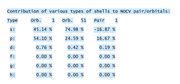
In the manual, there is no discussion on the meaning of the analysis. Is there any other way I can know the meaning of these numbers?
Offline
#4 2026-05-26 17:43:58
Re: Energy implementation of the ETS-NOCV analysis
I think this output is easy to understand. It is just the contribution of various angular moments to the NOCV orbitals and pair, so that you can better undstand its nature (Similar to the orbital composition analysis illustrated in Section 4.8 of Multiwfn manual).
Offline