Multiwfn forum
Multiwfn official website: http://sobereva.com/multiwfn. Multiwfn forum in Chinese: http://bbs.keinsci.com/wfn
You are not logged in.
- Topics: Active | Unanswered
#1 2026-04-10 09:49:22
- alessiomacorano
- Member
- Registered: 2023-12-19
- Posts: 18
Frequency calculation in benzene dimer π–π stacking
Dear Prof. Tian Lu,
First of all, thank you very much for your outstanding work on MULTIWFN and for managing the forum.
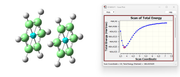
I am currently working on modeling π-π interactions between benzene dimers (Gaussian 16), for example in the “face-to-face” (FtF) geometry as shown in the attached figure. I performed the relaxed scan by keeping the monomer geometry fixed and optimizing the distance between them. I think I made a mistake because in the route section I used:
opt=modredundant gen nosymm geom=connectivity counterpoise=2 blyp and mpiricaldispersion=gd3 int=grid=superfine
without including the frequency calculation. So, to “fix” the error, I was thinking of saving the minimum geometry obtained from the relaxed scan and calculating the vibrational frequencies based on that with the freq keyword. Is this the correct procedure in your opinion?
If I obtain negative vibrational frequencies, how should I proceed?
Thank you in advance,
Alessio
Offline
#2 2026-04-10 20:29:29

Re: Frequency calculation in benzene dimer π–π stacking
Dear Alessio,
You should use the structure you shown as the initial structure to further optimize the dimer and then perform frequency analysis. Directly performing frequency analysis on a point of relaxed scan trajectory is commonly meaningless.
By the way, using B3LYP-D3(BJ) instead of BLYP-D3(0) is a better choice. Moreover, it is highly deprecated to perform relaxed scan or optimization in combination with counterpoise, because analytical gradient is not available when counterpoise is used, in this case the computational cost of these tasks is very high. 6-311+G* or def-TZVP without counterpoise is absolutely fine enough for present task.
Best regards,
Tian
Offline
#3 2026-04-13 12:41:23
- alessiomacorano
- Member
- Registered: 2023-12-19
- Posts: 18
Re: Frequency calculation in benzene dimer π–π stacking
Dear Prof Tian Lu,
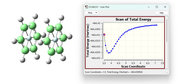
So if I understand correctly, I have to perform opt+freq for the structure corresponding to the step 1 as reported in the image ?
Finally, as a more general question, in this seminal work: https://doi.org/ 10. 1021/ ja025896h, as well as in other works by Sherrill David, it appears that the binding energy was calculated solely from the optimization of the inter-monomeric distance; I, too, optimized only the distance between the monomers in my calculations. I would kindly ask for your opinion on this, because I am a bit confused as to whether, in the calculations of binding energy for π-π interactions, the frequencies should be calculated or not at this point.
Thank you so much
my best
Alessio
Offline
#4 2026-04-14 02:10:21
Re: Frequency calculation in benzene dimer π–π stacking
Dear Alessio,
It is suggested to perform full opt for the lowest point of the scan curve to obtain the exact minimum structure of the dimer.
Note that the two benzene molecules are not exactly parallel with each other in the minimum structure of the dimer (though they visually look like very parallel), moreover, bond lengths and dihedrals vary (very slightly) during the complexation process. So, explicitly optimizing the minimum structure is recommended if you need the most accurate binding energy.
Best,
Tian
Offline
#5 2026-04-14 06:46:30
- alessiomacorano
- Member
- Registered: 2023-12-19
- Posts: 18
Re: Frequency calculation in benzene dimer π–π stacking
Dear Prof Tian Lu,
Thank you so much, this clears up the questions I had.
Thank you very much.
Alessio Macorano
Offline