Multiwfn forum
Multiwfn official website: http://sobereva.com/multiwfn. Multiwfn forum in Chinese: http://bbs.keinsci.com/wfn
You are not logged in.
- Topics: Active | Unanswered
Pages: 1
#1 Re: Multiwfn and wavefunction analysis » Tkatchenko-Scheffler C6 coefficient for an Excited State » Yesterday 11:49:36
Dear Tian Lu,
Thank you very much for your answer. I just tried and it worked:)
One last question: In case I would like to use Orca, should I generate the .molden file (using orca_2mkl) from the .gbw of a tddft calculation and then using Multiwfn (options 18,13) generate the natural orbitals file?
Thank you again,
Lorenzo
#2 Multiwfn and wavefunction analysis » Tkatchenko-Scheffler C6 coefficient for an Excited State » Yesterday 07:32:37
- Lorenzo
- Replies: 2
Good Morning, I came across the possibility of the ab-initio parametrization of C6 coefficients through the Tkatchenko-Scheffler method. I tried, as a preliminary test, to obtain the coefficients for benzene. My input file for ground state is:
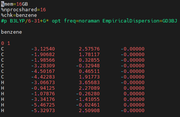
Everything runs fine and I obtain a value for the coefficent quite similar to Amber GAFF (using Hirshfeld-I partitioning and atmrad folder) using the .fchk file for the molecule and the .wfn files for carbon and hydrogen. Then, I wanted to check if excited states could also be dealt with. My input file for the excited state is:

Following the exact same procedure (substituting the .fchk file with the excited state one and keeping the same .wfn files for the isolated atoms as in the ground state), I obtain identical parameters for the C6 coefficients as if the program was reading the ground state density from the .fchk instead of the excited state density.
Could you please give me some insights abouth this?
Thank you very much for your help,
Lorenzo
Pages: 1